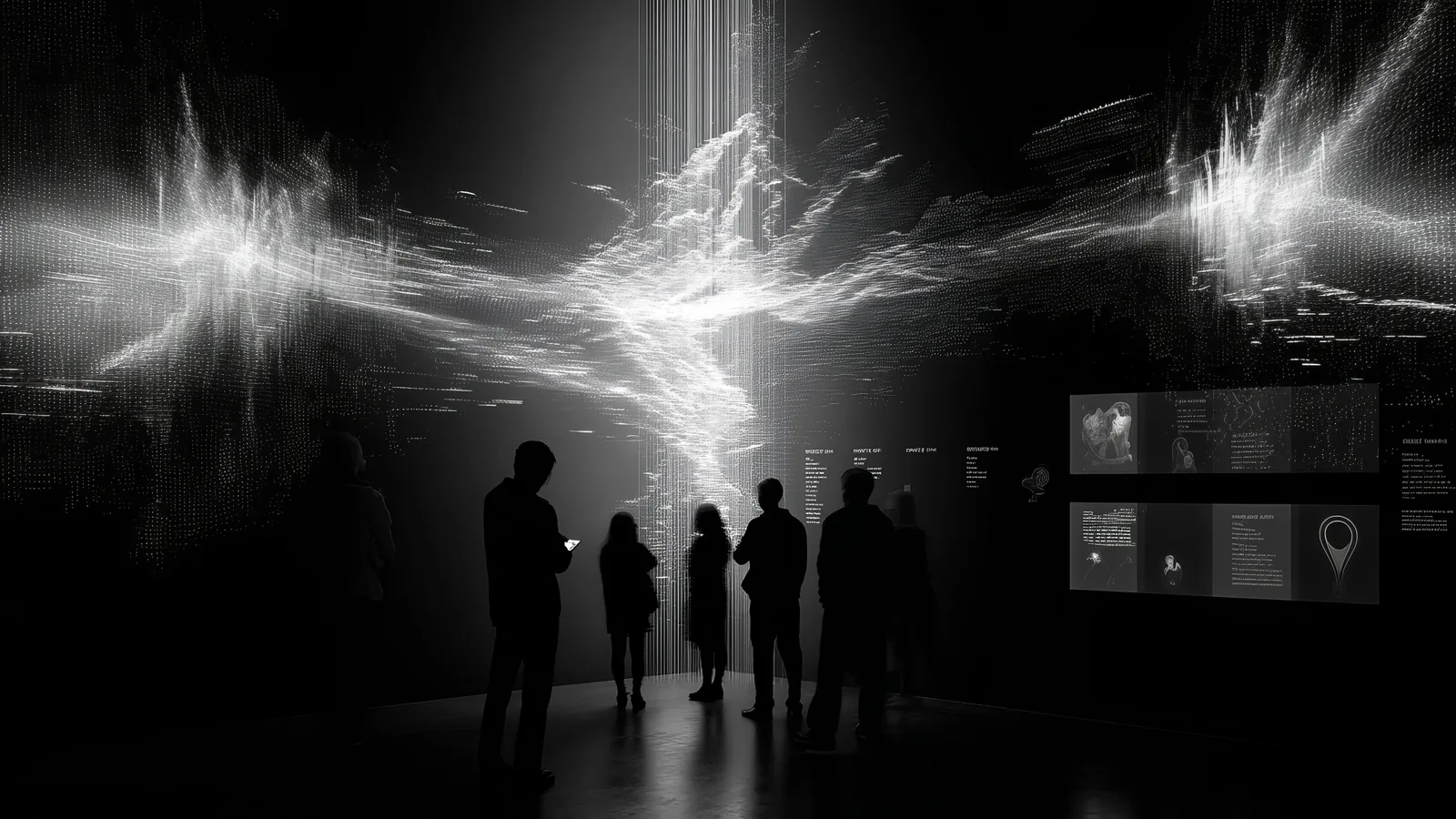
This article reads generative art as a transformation of the work-form: from concluded result to systemic process. Introducing the concept of Work-as-System, the text examines how artificial intelligence functions not only as a tool for media production but also as a framework for orchestrating relations, data and environments. Through reference to Jack Burnham and Systems Esthetics, it outlines a perspective in which the contemporary work manifests itself as a dynamic architecture, an ecosystem of meaning and a field of interdependent forces.
From output to system
Generative art has forcefully entered the vocabulary of the contemporary. Images, video, music, synthetic environments and automated generation processes now run through the art field with an ever wider presence. The decisive point concerns the transformation of the work-form: a shift is taking hold from the work understood as a concluded outcome to the work understood as process, system, architecture of relations.
By Work-as-System I mean a configuration in which the meaning of the work does not reside in an isolated object but emerges from the dynamic interaction among heterogeneous components: rules, data, environments, temporalities, devices and perceptual thresholds. The work no longer coincides with a finished result; it coincides with an operative field in which relations are organized and transformed. To read this transformation, then, it pays to shift attention from the output to the system.
Within this frame, the work presents itself as a dynamic configuration of rules, data, times, parameters, environments, perceptual thresholds and devices that activate meaning. Generative art thus acquires full theoretical value: it becomes one of the places where the contemporary most clearly exposes the redefinition of the very idea of the work.
Jack Burnham and Systems Esthetics
In this respect, Jack Burnham remains a decisive figure. In Systems Esthetics (1968) he identifies the shift from an object-oriented culture to a systems-oriented culture, replacing the finished, self-sufficient work with a constellation of environments, processes, relations and interdependent systems. His insight opens a theoretical field that is still fertile, because it allows us to read the work as a set of interactions, feedback loops and operative conditions rather than as a closed, autonomous entity.
Generative art sits squarely within this opening and intensifies its reach. The generation of images, video and music is one of the visible levels of a broader process, in which instructions, datasets, grammars, margins of variability, exhibition environments, temporalities and modes of activation are all at work. The sensory outcome gains strength within an extended structure capable of integrating form, process and operative condition.
AI as production vs AI as orchestration
At this point an essential distinction emerges. Some contemporary practices employ artificial intelligence as an apparatus of media production; others take it up as a framework for orchestration, research and data processing. In the first case, AI generates content. In the second, it organizes a field of possibilities: it coordinates variables, structures relations, modulates environments of meaning, articulates levels of activation. It is in this second horizon that the generative reaches a higher theoretical density and draws fully close to the logic of the Work-as-System.
The question widens further when research and data processing come into play. Within the horizon of the Work-as-System, artificial intelligence acts as an environment for investigating, selecting, correlating and organizing complexity. Models such as GANs show this dimension clearly: learning, comparison, selection, the statistical emergence of forms, the processing of datasets, the construction of possibilities. The generative thus stands at the intersection of the scientific, the aesthetic and the social.
The three components of the Work-as-System
The scientific component concerns models, correlations, parameterization and operative architectures. The aesthetic component concerns the birth of visual, sonic, spatial and temporal configurations. The social component concerns the nature of the data, filters, selections and cultural hierarchies embedded in every process of training and generation. The generative then reveals itself as the place where the processing of the real meets formal imagination, and where technical infrastructures become poetic and critical material.
This is where the concept of Work-as-System gains substance. With this expression I designate a configuration in which meaning emerges from the dynamic relation among heterogeneous components: image, sound, space, time, text, environment, data, algorithm, process and critical vision. The work takes shape as a relational organism, an operative membrane, an architecture of forces that generate, regulate, activate, expose and transform meaning.
The ecosystem of meaning
Generative art thus finds a fully contemporary place. The generative appears as a device for research, for building relations and organizing complexity, more than as a mere technique for producing images or special effects. The output keeps its importance, but finds its meaning within a broader structure capable of integrating vision, environment, process, data and activation. The work thus manifests itself as an ecosystem of meaning.
Productive use vs systemic use
For anyone working today with images, video, music, immersive environments, algorithmic panels, soundscapes and generative practices, this distinction is a decisive point. The productive use of AI activates forms and languages. The systemic use of AI builds the conditions for the work to emerge: process becomes structure, structure becomes relation and relation becomes living form.
Placing generative art within the contemporary dialectic means recognizing it as one of the places where the very idea of the work is being redefined today. Burnham offered a first vocabulary for understanding the slide from object to system. The Work-as-System tries to name the current form of this transformation, at the point where image, space, time, data, algorithm and critical vision converge in an interdependent configuration.
Here generative art finds its highest meaning. The production of images, video and music expands into a practice of research, processing, activation and the emergence of meaning. The work appears as a living system, a field of forces, a structure of relations, a mobile architecture. The generative thus enters the heart of the contemporary question, where art manifests itself as process, vision and the construction of complexity.
Dario Buratti · www.darioburatti.com
Bibliography and references
Jack Burnham, Systems Esthetics, Artforum, vol. 7, no. 1, 1968, pp. 30–35.
PDF available here
Luke Skrebowski, All Systems Go: Recovering Jack Burnham’s “Systems Aesthetics”, Tate Papers, no. 5, 2006.
https://www.tate.org.uk/research/tate-papers/05/all-systems-go-recovering-jack-burnhams-systems-aesthetics
Systems Aesthetics + Cyborg Art: The Legacy of Jack Burnham, Sculpture Magazine, 2021.
https://sculpturemagazine.art/systems-aesthetics-cyborg-art-the-legacy-of-jack-burnham/
Dario Buratti, L’arte generativa è l’ultima erede dell’arte concettuale? Estetiche dell’opera-sistema da Umberto Eco all’IA Artribune, January 22, 2026.
https://www.artribune.com/arti-visive/2026/01/opera-sistema/