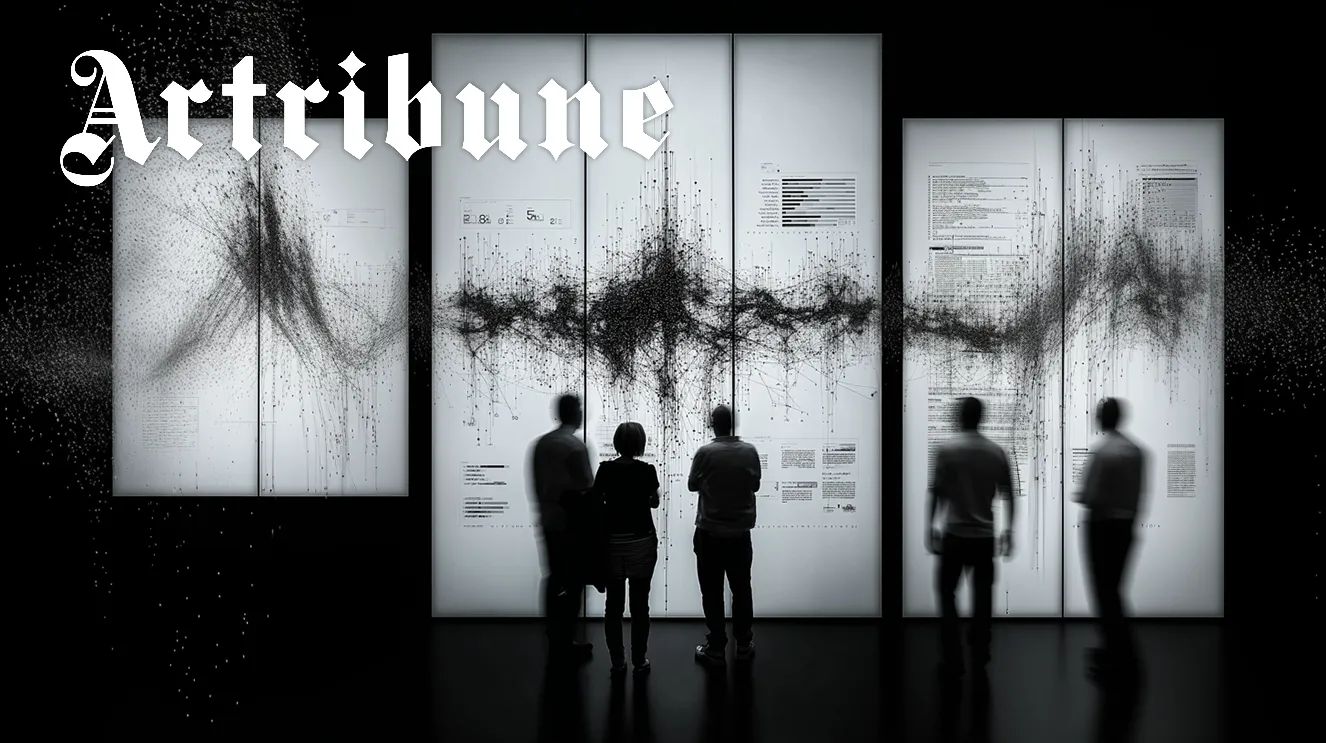
A paradox runs through the public debate on artificial intelligence and art: the more spectacular generated images become, the more the figure of the author seems to fade. People talk about prompts as if they were enough to explain a work, outputs are mistaken for the signature, and the craft is filed away under the label AI art as though it were a technological effect rather than a practice. In the densest generative works, however, the opposite happens: every image is the local effect of a system that, underneath, keeps on deciding.
The most attentive institutions do not describe the phenomenon as a prompt contest. Tate defines generative art as art made through a predetermined system, often open to chance, in which the apparatus of rules is the center of the process. The V&A describes digital culture as an ecosystem in which generative art, data visualization and computational environments turn data and algorithms into visual and narrative materials. That is where the game is played: on the system-form of the work rather than on the final image.
From prompt to system: the work as an ecology of decisions
In a previous article for Artribune I wrote about the Work-as-System as a work that coincides with the grammar that makes it possible: instructions, constraints, datasets, timings, display. Here I would like to narrow the field to a concrete consequence: if the work is a system, then it can no longer be described as a finished object. It is an ecology of decisions that stays alive, a project of conditions rather than of things.
Data-driven practices push this logic to its limit. Data stops being a reference and becomes active matter: it constitutes the perceptual environment, shapes the narrative structure, dictates duration. It is not an illustration of the present, it is a direct grip on the present. Jack Burnham (New York, 1931–Chicago, 2019) sensed this half a century ago, anticipating the shift from a culture of objects to a culture of processes: but today that legacy serves to understand what is happening inside the computational infrastructure, not to repeat the genealogy.
Two works, distant in technology and close in logic, keep the point in view. Condensation Cube (1963-1965) by Hans Haacke (Cologne, 1936) is a Plexiglas cube in which condensation forms, runs and evaporates according to light and temperature: the work is the behavior. Unsupervised (2022) by Refik Anadol (Istanbul, 1985) trains a machine learning model on MoMA’s archive and gives the collection back as a dynamic stream of abstract images generated in real time: the work is the entire architecture, dataset, model, code, museum environment, stream. In both cases what we see is the sensory surface of a system that keeps on deciding.
The artist as systemic director
If the work takes on a systemic form, the figure of the artist changes. The artist is no longer the one who chooses the right image: the artist is the one who designs the conditions under which certain images, and not others, can emerge. I call this figure the systemic director, and I speak of Systemic Direction as a specific practice. The systemic director builds workflows, defines constraints, organizes relations between data and forms, instructs algorithms, sets thresholds of variation, shapes the dramaturgy of selection.
In an AI-driven context, instructing the machine becomes primary artistic work: which archives become the training base, how they are filtered, which examples are favored and which excluded, what relation is established among training, prompts and corrections over time. The prompt remains, but only as the activation threshold of a system that has been prepared to react in one way and not another. The authorial signature no longer lies in the final gesture: it lies in the quality of the system, in the behaviors it activates, in the coherence of the outcomes it allows to emerge.
Style as the distributed signature of the systemic director
Style, too, changes place. It stops being a set of recognizable traits on the image and becomes a specific way of organizing rules, data, visualizations, environments, a signature distributed across the behavior of the system. In art that uses generative models, style lives in the choices of instruction: which archives are offered to the model, how examples and counter-examples are balanced, how much control is exercised over parameters, how much freedom is granted to emergence. Two artists can work with the same models: their respective forms of Systemic Direction will produce incommensurable aesthetic worlds.
ResNet XX: instructing the machine to see the present
In my own work this logic took concrete form with ResNet XX · The Geopolitical Sublime (2026), the most advanced work in the Resonance Networks series. The system monitors accredited geopolitical sources in real time (conflicts, crises, global tensions) and organizes that data into ephemeral datasets, mapped through a generative neural network into aesthetic coordinates: colors, geometries, visual densities, movements. The immersive audiovisual output is accompanied by Residual Code Poetry read by a synthetic voice. My role has never been to choose the right image: it has been to select the sources, define the activation thresholds, build the grammar that links data, image, sound and language. I did not sign the outputs, I signed the system that makes them possible. Every evening the work is different because the world is different.
To speak of Work-as-System and Systemic Direction, then, means looking beyond the narrative of AI as a factory of automatic images, and recognizing that artistic work today consists in designing complex conditions: organizing the possible, building operative worlds, deciding which relations the machine can activate and which forms of experience can enter cultural space. The question to start again from is no longer which image to generate, but which worlds a system is authorized to show. Everything else is skin.
Dario Buratti