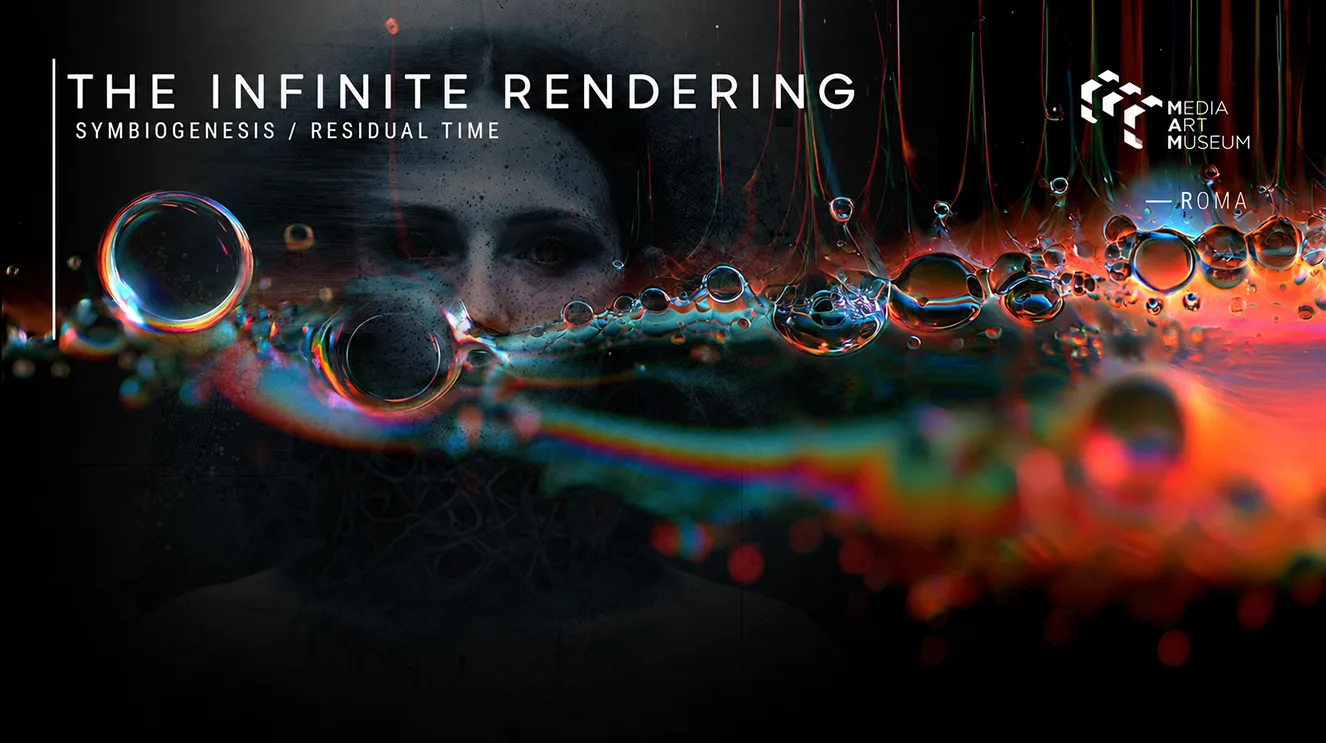
At the MAM in Rome, the Work-as-System took shape through the inaugural fragment of The Infinite Rendering, the first experience of the corpus Symbiogenesis / Residual Time, which we are developing with Carlo Alfano. For the opening on October 9, 2026, we conceived six minutes of immersive cinema: the entry point into a body of research meant to move across cinema, space, matter and performance.
What passes from a film into the space that hosts it? What remains when images take on volume and ask the body to find a different position? These questions accompanied the preparation and continue to guide the work. I keep coming back to them as we try to understand how one form can carry on its life inside another.
The MAM in Rome and the inaugural exhibition HyperMedia
The MAM, Media Art Museum in Rome, opened on October 9, 2026, at Corso d’Italia 37/D. The exhibition HyperMedia accompanied the opening, bringing the history of digital culture into dialogue with contemporary artistic practices. The museum’s spaces include an immersive room in which the walls and the floor take part in building the experience.
For our work, composing on these surfaces became part of the writing itself. A voice, an image or a cut had to find its place in relation to the body of the viewer. From the very beginning, the room became a condition we had to reckon with.
In my previous article published in Notiziarte, I approached the Work-as-System through the relationships among forms, processes and generative conditions. At the MAM, this perspective met shared work: direction, durations, images and sounds forced us to pin down what could remain open in the theoretical formulation.
Carlo Alfano was responsible for the direction and the Storyverse. My contribution consisted in bringing into the work the generative grammar and the method developed through the Work-as-System, Systemic Direction and Residual Time.
It was an encounter between authorial practices, with distinct responsibilities and a common ground for elaboration. The narrative construction and the generative one had to find a way to act together, all the way to the concrete form of the presentation.
The Infinite Rendering and reticular cinema
In the fragment of The Infinite Rendering, the story was distributed across the four walls and the floor through five synchronized channels. An event could draw attention to one wall while something else kept happening elsewhere. The floor also took part in the composition, altering the relationship between image and body.
We call this mode Reticular Cinema Immersivo. The term designates a precise compositional choice: treating the configuration of the surfaces at a given instant as the unit of the story. Editing by succession is joined by editing by simultaneity. A scene therefore includes the relationships among events that occupy different points of the room.
In the inaugural fragment, a point of light appeared simultaneously across the surfaces. From that point the lines of the grid emerged. Within it, a vertical city took shape, swept by acid rain.
The city held three presences: a man worn down by the effort to bring something to completion, an artificial intelligence that decided to give itself a name, Grace, and the voice that addressed whoever stood in the dark.
At a certain moment a crack ran through the walls and the floor. Up to that threshold one heard the generative sound of the system; from there a cello came in. The relationship among these elements belonged to the writing of the work as much as their visual form did.
Systemic Direction was at work here too, in the conditions that allowed image, space and sound to sustain the same event.
A fragment conceived for the opening
The length of the fragment raised a question for us: how do you introduce a work that is still meant to develop?
We chose a section that stopped at its own threshold. A montage of the main moments would have anticipated a synthesis, suggesting a path already reassembled. The fragment instead preserved the tension of the stretch it crossed, leaving open what would follow.
These six minutes were designed for the opening of the museum. They presented the language of the first episode and, through it, the broader project. Those who encounter the film later will be able to recognize that section and place it within a different duration.
The material arose from generative systems on which we intervened by defining a grammar. The presentation in the room was a fixed execution, made up of five synchronized channels. The projected fragment had a set duration and sequence. The process that produced it encompassed the choices, constraints and possibilities through which we arrived at that configuration.
Reading the Work-as-System at the MAM also means taking these steps into account. Generation, selection, editing and arrangement in space all involved authorial decisions. Their relationship makes it possible to understand which part of the research can continue beyond the film.
Symbiogenesis / Residual Time: four forms of a corpus
The ArTech Team corpus Symbiogenesis / Residual Time comprises four moments, designed according to the verbs Telling, Crossing, Inhabiting, Fusing:
- The Infinite Rendering: the immersive cinematic experience.
- The Membrane: the traversable path.
- Solid State: the inhabitable volumetric configuration.
- Live State: the live performance.
The inaugural presentation introduced the first moment through the six-minute fragment. The manifestations that follow the film belong to the planned development of the corpus. Their relationship is already a working question.
Moving from a sequence to a path means entrusting part of the duration to the movement of whoever enters. Giving volume to an image introduces bulk, distance, an obstacle or a chance to draw closer. Bringing these materials into performance exposes the composition to the conditions of execution.
What interests me is understanding which relationships can carry through these changes. The presence of the same characters or of recognizable images establishes certain links. Yet the most demanding question remains: what does each experience inherit from the one that preceded it? And how much does this inheritance weigh on the decisions we can still make?
Residual Time in the construction of the work
It is on this ground that Residual Time becomes a compositional criterion. With this expression I describe the capacity of a trace to keep acting after its own appearance. Within the corpus, we have to test what consequences such persistence can have.
An image from the film might return in a later manifestation, retaining above all a function of recognition. It might also impose a spatial relationship, condition a duration or call for a transformation of the sound.
In the second case, the earlier work takes part in building what comes after. To find out whether this happens, one has to follow the decisions, observe what changes and for what reason.
The viewer’s memory belongs to another plane. Returning to the same fragment, each person may catch a relationship that slipped by during the first viewing. The channels play the same sequence, while attention orients itself differently. This experience has a value of its own; distinguishing it from the transformation of the process helps us be precise about what actually takes place.
The fragment presented at the MAM also introduced this field of research. Between one manifestation and the next there will be decisions to revisit, materials to let go and relationships to preserve. That is where we will look for the continuity of the corpus.
When we reach the live performance, I would like to be able to recognize what the film, the path and the matter will have made possible. And to understand which choices will have arisen precisely from the impossibility of forgetting what we will already have done.
Dario Buratti